
How Executive Function Affects Function
Executive function involves the mental processes or abilities that enable users to tread through every day life.
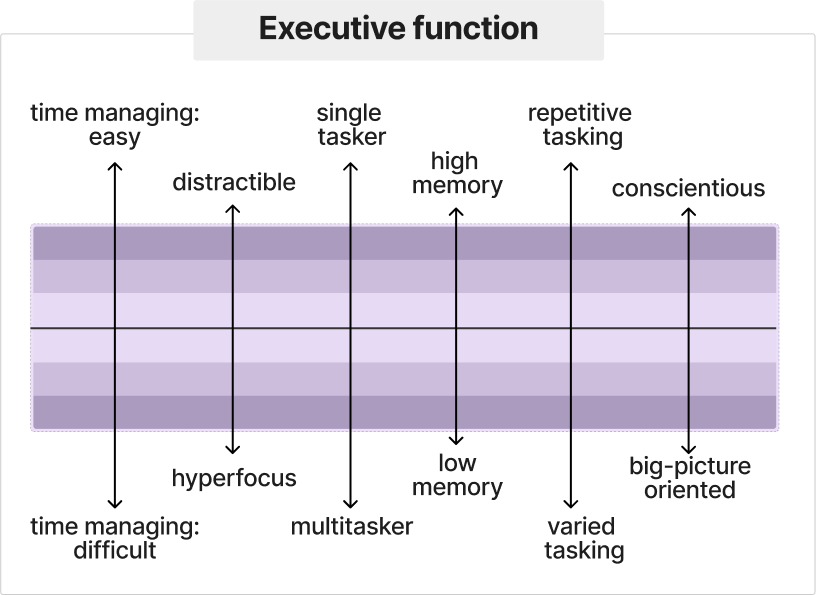
There are five key traits of Executive Function:
- Time management ability (easy to difficult)
- Concentration (distractible to hyperfocus)
- Tasking approaches
- (single tasker to multitasker)
- (reptitive tasker to varied tasker)
- Memory function (high to low)
- Broadness of focus (conscientious to big-picture-oriented)
| Time management ability | Time management ability might seem straight forward. It’s easy to simplify it to either a user is really good at it, or really bad at it. Someone who seems really good at it might appear to have it together and always delivering on what they promise or commit to, while someone who’s not so great at it might miss meetings or commitments. They might struggle with estimating the time a task or activity might take, leading to conflict. Outside of this binary though, are those who are really great at faking it. They might look like they are super organized and consistently hitting all their deadlines, checking all their boxes. The reality though is that these time jugglers are struggling hard to maintain this reputation of normative behavior. They need help. They’re slipping on the brink of burn out, but they aren’t going to ask for it because they want to keep up the facade. Let’s help them before they fall. |
| Concentration | Concentration is a skill, but it’s also affected by environment. This scale specifically calls out how someone might be distracted more easily or less easily by things like background noise, and how much they might struggle with transitioning back after an interruption. |
| Task approaches | The task approaches boil down to two things: 1) if a user is often attempting to access your product while multitasking or if they usually wait until they can dedicate their full attention and device bandwidth to it. Are they trying to use it hands-free? Are they limited by their environment and multi-tasking involuntarily? Is your product forcing them to multitask by requiring complex analysis to figure out how to navigate it? AND 2) if a user prefers activities that repeat over and over the same way each time or activities that are different and novel formats. If they prefer repetition, they might get confused if the experience is too complex, and if they prefer varied, they might become understimulated or bored quickly. |
| Memory | Memory is super important for function. In particular, short-term memory, including working memory, can store and process the information needed to complete activities, help with reading comprehension and retrieval, and support effective communication. Some learners might have a hard time with remembering content if they have to juggle multiple applications, pages, and browser windows or inconsistency between devices. |
| Broadness of focus | Some conscientious users might get stuck on minor or seemingly insignificant details of a product that don’t actually affect functioning. Alternatively, users who are big-picture-oriented can identify patterns within information by taking a systems-level perspective, but they may overlook minor errors or typos in their work. |
Research
[115] Carolyn MacCann, Gerard J Fogarty, and Richard D Roberts. Strategies for success in education: Time management is more important for part-time than full-time community college students. Learning and Individual Differences, 22(5):618–623, 2012.
[116] L Mark Carrier, Larry D Rosen, Nancy A Cheever, and Alex F Lim. Causes, effects, and practicalities of everyday multitasking. Developmental Review, 35:64–78, 2015.
[117] Rachel E Avery, Luke D Smillie, and Jan W de Fockert. The role of working memory in achievement goal pursuit. Acta psychologica, 144(2):361–372, 2013.
[118] Nelson Cowan. What are the differences between long-term, short-term, and working memory? Progress in brain research, 169:323–338, 2008.
[119] Tracy Packiam Alloway. A comparison of working memory profiles in children with adhd and dcd. Child Neuropsy- chology, 17(5):483–494, 2011.
[120] Adar Ben-Eliyahu. Academic emotional learning: A critical component of self-regulated learning in the emotional learning cycle. Educational Psychologist, 54(2):84–105, 2019.